
22 June 2026. Rodney ratepayer contribution to Auckland Council rises to $164 million as councillor calls for rates review.
The total amount of rates collected from Rodney ratepayers by Auckland Council has increased from $149 million per annum last year to $164 million this year, according to figures sourced by Councillor Greg Sayers. 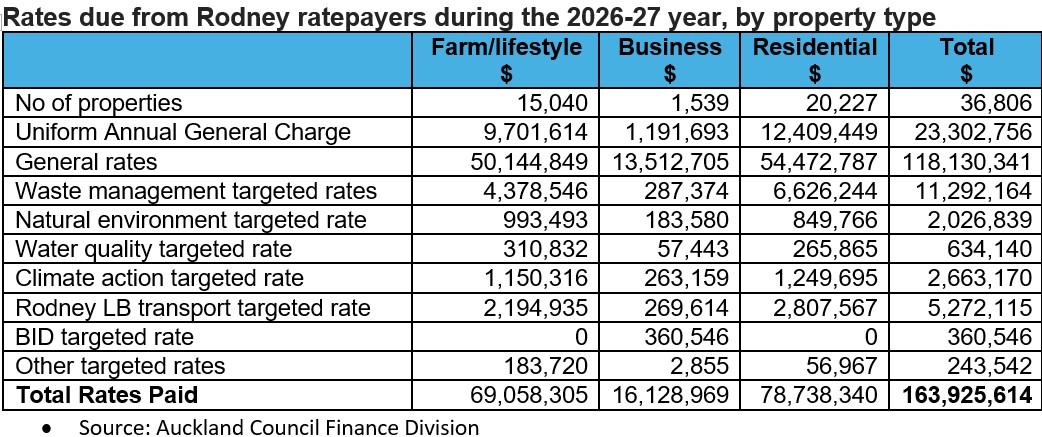
Auckland Council’s rates revenue is pooled to fund a wide range of services, infrastructure, and community facilities across Auckland. The system is made up of several components, including general rates, the Uniform Annual General Charge (UAGC), and targeted rates.
The UAGC is a fixed fee applied to every separately inhabited part of a property, regardless of its value or size. It is intended to ensure all ratepayers contribute a baseline amount toward council services.
Cr Sayers says the UAGC is not well understood by many residents but believes it could play a key role in reducing the rates burden on Rodney households.
“If the Council is serious about lowering rates bills for Rodney ratepayers, it should increase the uniform annual charge paid by all Auckland households and decrease the general rates paid. This would spread a greater proportion of rates burden costs across all of Auckland and overall the rates bill for Rodney’s ratepayers would drop,” he said.
He is seeking support from Mayor Wayne Brown and fellow councillors to put the proposal forward for public consultation ahead of possible implementation from July next year.
“I have also sort support from the Mayor to undertake the serious exercise of defining what is Council’s core business,” says Sayers. ” When Mayor Goff looked at this nothing changed. I am hoping Mayor Brown can do better.”
The general rate component remains the council’s primary funding mechanism for region-wide services such as libraries, pools, parks, roads, and stormwater systems. It is calculated based on a property’s capital value and the rate increase set by council. 
Targeted rates are additional charges applied to fund specific services or projects, including environmental initiatives such as pest control and kauri dieback protection through the Natural Environment Targeted Rate. Some properties also pay additional targeted rates for services such as rural drainage schemes.
Alongside rates, Auckland Council also generates significant income through fees, charges, government grants, subsidies, and investment returns.
Cr Sayers says rates account for approximately 40 per cent of council revenue, with the remaining 60 per cent coming from other sources. He says the council operates a “user-pays” model for many services.
These include public transport fares, Watercare charges for water and wastewater services, regulatory and licensing fees for consents and permits, facility hire and entry fees, and development contributions from property developers funding infrastructure expansion.
However, Cr Sayers has raised concerns about how some of these charges are applied and what they ultimately fund.
“I support a user pays model. However, the majority of the income from fees is being used to cover wages,” he said. “What worries me is it’s become a distorted a cost-plus model to bolster staff numbers.”
He noted that the average cost of processing a standard non-notified residential resource consent in Auckland is over $10,000, with additional consultant costs often adding around $27,500.
Development contributions have also come under scrutiny, with Cr Sayers estimating Rodney processes between 400 and 600 building consents annually. Based on average contributions of around $17,000 per consent, this raises between $6.8 million and $10.2 million each year.
He argues that the definition of “local” for Rodney-related contributions is too broad, claiming funds are being redirected to infrastructure in areas such as Redhills, Whenuapai, and Westgate.
“This policy definition needs to be tightened and I’m working closely with the Rodney Local Board because we desperately need that money spent on our local infrastructure deficits,” he said.
Watercare revenue was also highlighted, with Cr Sayers estimating around $17 million is collected annually from addional water charges (not rates), including approximately $6 million from the Mahurangi area. He says this funding supports significant infrastructure investment, including a $500 million upgrade programme for Warkworth, Snells Beach, Wellsford, and Te Hana.
“This is one area from the Council where Rodney is getting good value for money,” he said, adding that the charges also support ongoing maintenance of the existing water infrastructure.
Watercare also has several major water and wastewater infrastructure projects across Auckland’s northwest. These include the recently completed $17 million Helensville Wastewater Treatment Plant upgrade, the long-standing Kumeu, Huapai, and Riverhead pressure sewer network, and ongoing bulk network upgrades to support continued residential and commercial growth.
Wastewater from Riverhead, Kumeu, Huapai, and Whenuapai currently flows to the Māngere Wastewater Treatment Plant. Watercare is undertaking a multi-billion dollar, progressive infrastructure program to extend the Northern Interceptor pipeline to Westgate and Henderson by 2029 and 2036, respectively, to redirect northwest flows to the Rosedale plant to improve the wastse water services to Riverhead and Kumeu.
Cr Sayers says while he is please to be able to identify and make public the table about how much Rodney ratepayers contribute, he remains frustrated by what he describes as a lack of detailed breakdown for public consumption about how those funds are allocated back into Rodney.